Press Release
GoldHold Launches Persistent Memory for AI Agents
Iron Ridge, WI. February 25, 2026. For Immediate Release
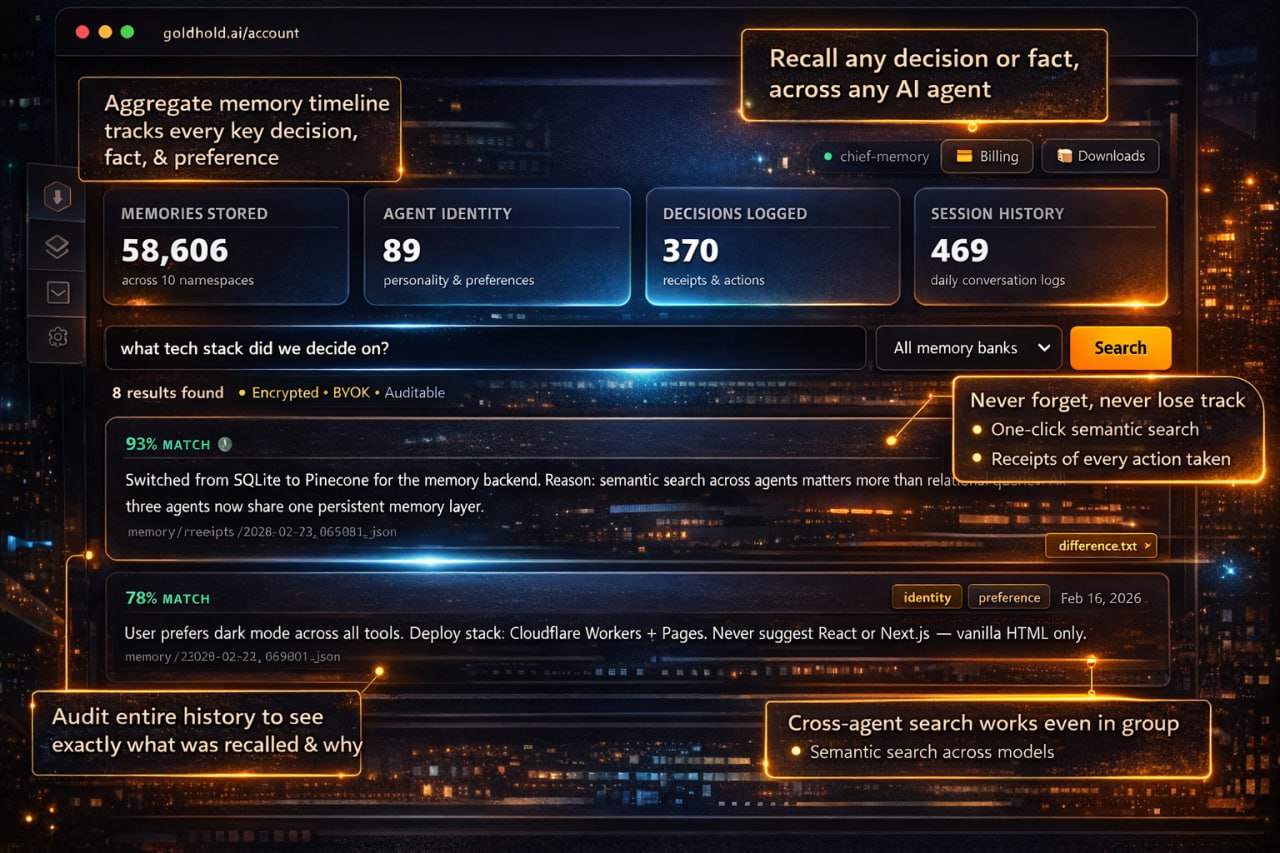
All Auto Tunes LLC today announced the public beta of GoldHold, a persistent semantic memory system that gives AI agents crash-resilient memory across platforms, restarts, and context window resets.
The Problem
Every AI agent today suffers from the same limitation: when the context window fills up or the session ends, everything the agent learned disappears. Decisions, preferences, project history, corrections -- all gone. Users repeat themselves. Agents start from zero.
For developers running AI agents across multiple platforms. Claude, ChatGPT, OpenClaw, LangChain, CrewAI. the problem compounds. Each platform is an island. Nothing carries over.
The Solution
GoldHold solves this with a persistent memory layer that sits between the user and their AI agents. Built on Pinecone vector database with GUMP packet-based audit trails, GoldHold gives every agent access to the same shared memory. decisions, corrections, project context, and learned preferences.
What one agent learns, every agent remembers. Switch platforms and keep everything.
Key Features
- Crash-resilient memory: survives restarts, context compaction, and total system wipes
- Cross-platform: works with OpenClaw, Claude Desktop, Claude Code, Cursor, Windsurf, Cline, Continue, Roo Code, ChatGPT, LangChain, CrewAI, AutoGen, and any REST-capable agent
- 22+ integration formats: MCP clients (Claude Desktop, Claude Code, Cursor, Windsurf, Cline, Continue, Roo Code), Python frameworks (LangChain, CrewAI, AutoGen, Semantic Kernel, OpenAI Tools, raw REST), cloud and enterprise (Cloudflare Workers, Vercel, AWS Lambda, Docker, Kubernetes), plus ChatGPT Plugin, OpenAPI, and OpenClaw Skill
- 2-minute setup: sign up, generate API key, paste one line
- Decision audit trail: GUMP packets with hash-chain integrity for every decision, correction, and action
- Semantic search: vector-based recall, not keyword matching
- Background sync: four independent sync cycles run automatically (Git, Pinecone, Pacemaker, Vault)
- Private by default: isolated namespace per account, encrypted in transit and at rest. BYOK available for full control
Architecture
GoldHold uses four pillars: Pinecone for semantic vector search, GitHub for version-controlled file storage, a GUMP packet system for decision audit trails, and Vault (R2) for binary asset storage. A background Guardian process runs continuous sync cycles, with a Watcher that monitors and auto-repairs failures.
Pricing
GoldHold is available in four tiers:
- Lite (Free): 1 agent, 1 folder, full memory engine, auto-sync, crash recovery, basic dashboard. No credit card required.
- Vault ($9/month): unlimited agents and folders, cross-platform sync, full dashboard, memory export, priority support. 7-day free trial.
- Vault Pro ($84/year): everything in Vault, billed annually. Best value -- founding supporter pricing.
- Enterprise (custom): R2 Vault storage, SSO, team management, dedicated support. Contact us.
Intellectual Property
GoldHold and OpenJar are protected by USPTO Provisional Patent Application #63/988,484, filed February 19, 2026. The filing covers 64 claims (16 independent + 48 dependent) across two product families, part of a broader portfolio of 172 total claims across 7 product families.
Family F1: AI Persistent Memory Architecture (GoldHold)
32 claims (8 independent + 24 dependent) covering the core memory system:
BB-1Phantom Headroom Context Window Configuration
Declaring a context limit smaller than actual to prevent quality degradation and enable graceful compression.
- DEP A: Declared limit at least 25% smaller, establishing phantom headroom for full compression cycle
- DEP B: Background compression triggered when token consumption reaches threshold of declared limit
- DEP C: Model instructed via system prompt to treat declared limit as actual capacity
BB-2Receipt-Based AI Accountability Layer
Structured JSON records for every agent action including type, inputs, outputs, timestamp, authorization tier, and outcome.
- DEP A: Records stored in both local filesystem and vector database for semantic search
- DEP B: Record history used as behavioral signal for future agent decisions
- DEP C: Cryptographically-timestamped snapshots providing immutable audit trail
BB-3Triple-Layer Memory Synchronization
Local filesystem + vector database + version-controlled snapshot storage, synchronized with resolution priority on divergence.
- DEP A: Sync triggered by time elapsed, token consumption, or action count. whichever first
- DEP B: Vector database authoritative when local unavailable, snapshots as fallback
- DEP C: Each sync event generates a receipt in the accountability layer
BB-4Session Continuity Gate and Deja Vu Recovery
Detecting session discontinuity and reconstructing agent context from persistent memory snapshots.
- DEP A: Snapshots capture active tasks, pending decisions, last action, open questions, prior commitments
- DEP B: Recovery acknowledgment explicitly identifies the event for human collaborators
- DEP C: Multiple snapshot candidates ranked by recency and completeness
BB-5Adaptive Heartbeat Memory Consolidation
Monitoring stress indicators and increasing consolidation frequency under compound stress conditions.
- DEP A: Continuous monitoring with dynamic frequency adjustment, not fixed schedule
- DEP B: Compound stress defined as 2+ indicators simultaneously exceeding thresholds
- DEP C: Frequency returns to baseline when all indicators fall below thresholds
BB-6Capability Card Documentation Architecture
Slim capability cards in context window, full documentation in vector DB for on-demand retrieval.
- DEP A: Card installed as patch to existing config, adding index without replacing content
- DEP B: Card updated when docs change without agent restart or full context reload
- DEP C: Card describes what to search for, teaching query behavior rather than knowledge
CP-1Cross-Product Shared Namespace Vector Memory
Single vector DB partitioned into product-specific namespaces with cross-namespace collaboration.
- DEP A: Distinct scoring policies per namespace, including corrections boost
- DEP B: Separate namespaces for memory, receipts, documentation, and corrections
- DEP C: Authorization layer controls cross-namespace queries
CP-3Outcome-Derived Corrections Feedback Loop
Real-world corrections indexed and boosted in retrieval to override theoretical knowledge.
- DEP A: Boost empirically calibrated to surface corrections without overriding unrelated theory
- DEP B: Corrections indexed with provenance: original recommendation, outcome, delta, timestamp
- DEP C: Pattern applies across multiple products sharing common vector infrastructure
Family F3: Multi-Model AI Orchestration (OpenJar)
32 claims (8 independent + 24 dependent) covering multi-model coordination:
OJ-1Post-Synthesis Retrospective Refactor Loop
All models critique the final answer; conditional auto-refactor when any model signals improvement.
- DEP A: Designated synthesis model applies discriminating judgment on improvements
- DEP B: Machine-readable boolean indicating whether post-synthesis refinement occurred
- DEP C: Confidence score derived from retrospective consensus proportion
OJ-2Strength-Based Multi-Model Task Assignment
Sub-problems assigned to models based on documented capability strengths with explicit rationale.
- DEP A: Assignment rationale included in prompt for role-calibrated responses
- DEP B: Sub-problem count bounded between 2 and 5
- DEP C: Capability profiles define per-model strengths: synthesis, review, code, contrarian, research
OJ-3Multi-Organization Model Cross-Check
Models from 3+ organizations with round-robin review and conflict avoidance.
- DEP A: Conflict avoidance advances assignment when reviewer matches author
- DEP B: Aggregated confidence ratings produce ensemble confidence score
- DEP C: All cross-check findings delivered to synthesis model simultaneously
OJ-4Persistent Shared Team Memory
Every solved problem indexed to shared vector DB; past solutions injected as prior context.
- DEP A: Memory storage executes asynchronously, non-blocking after response delivery
- DEP B: Records include contributing model identifiers and refinement boolean
- DEP C: Confidence scores surface during retrieval for weighted results
OJ-5Failure-Resilient Parallel Pipeline
Structured error tokens instead of exceptions; pipeline continues with remaining outputs.
- DEP A: Structured tokens contain failure reason for downstream routing
- DEP B: Synthesis model adjusts confidence when working with partial outputs
- DEP C: Response metadata identifies which models contributed successfully
OJ-6Pre-Flight Balance Verification with Machine-Readable 402
Estimates total pipeline cost before execution; returns structured 402 when balance insufficient.
- DEP A: Cost estimation accounts for all parallel calls with worst-case estimate
- DEP B: 402 response parseable without documentation for automatic client redirect
- DEP C: Universal token currency normalizes costs across providers
OJ-7Deterministic Pseudo-Embedding Fallback
Maintains vector DB operations during embedding API failures using deterministic vectors.
- DEP A: Pseudo-embedding dimensionality equals production model for schema compatibility
- DEP B: Same input always produces same vector for search consistency
- DEP C: Fallback events logged for reliability analysis
OJ-10Multi-Provider AI API Cost Normalization via Universal Token Currency
Universal token unit with fixed exchange rates per provider; single unified balance across all providers.
- DEP A: Adjustable exchange rates with margin, independent of billing architecture
- DEP B: Tiered pack purchasing in universal units, decoupled from provider rate changes
- DEP C: Per-provider consumption tracked at pipeline phase level with cost receipts
These 64 claims are part of a broader portfolio of 172 total patent claims (43 independent + 129 dependent) across 7 product families filed by All Auto Tunes LLC. All claims have an established priority date of February 19, 2026.
About All Auto Tunes LLC
All Auto Tunes LLC is a Wisconsin-based technology company building infrastructure for the AI agent ecosystem. Founded by Jerry Simmons, the company develops tools that make AI agents more reliable, persistent, and useful for real-world work.
Media Contact
Jerry Simmons, Founder
All Auto Tunes LLC
support@goldhold.ai
goldhold.ai